

Legacy Industrial Communications is alive an well
Keep the legacy, update the communications path
In world of IP, security threats and raw economics, the need to retain legacy business, government, industrial, and Utility communications equipment, hardware, and solutions has never been greater. Two major goals are always achieved by retaining the security of not having to rely on direct public Internet connectivity, utilizing proven older communications methods that are more analog in nature, and continuing to prolong the initial return on investment (ROI).
Pulse Supply is a premier telecommunications equipment supplier and master distributor of enabling technologies for next-generation networks. We specialize in bridging the gap between legacy reliability and modern IP and cellular communication architectures. For the industrial and utility sectors, **Pulse Supply proudly represents and distributes RAD SecFlow solutions and products**, bringing heavy-duty, industrial-grade communication platforms directly to these thousands of facilities.
Legacy Industrial and Utility Communications Systems
The communications landscape has evolved at an unbelievable rate, but not without issues that affect many segments of business and government infrastructure. In a world where standard IP applications and connectivity solutions appear the only solution, the reality of complexity and security prove themselves as high risk ventures with little gaurantee that the goal of overall improvement is achieved. Every day we see the largest technology companies on the planet are compromised at record levels with hours or days of downtime. Let's face the facts, this just happens less with legacy based communications that don't advertise themselves on the Public Internet where anyone on the planet can attempt to access the communications system that are so important to daily operations. These include:
- Utility companies delivering core services for water, electricity, natural gas, sewage, and steam
- Government transportation services including aviation, trains, subways, buses, maritime, roads and highways
- Industrial business that need to remote control their assets
- Logistics Automation
- Facility and Asset Inspection
- Older 2G and 3G communications with older technology and protocols like "AT" commands
- SCADA environments
- Facility and Campus connectivity
Don't give up Firewalls and Encrytpion
The perception of legacy and modern communications can easily be misleading and facilitate costly decisions. When properly thought out, the use of legacy communications combined with modern devices that simply encapsulate these legacy technologies with inherent security and give them a pathway to the future while further enhancing the security with modern encryption over alternate communication methods.
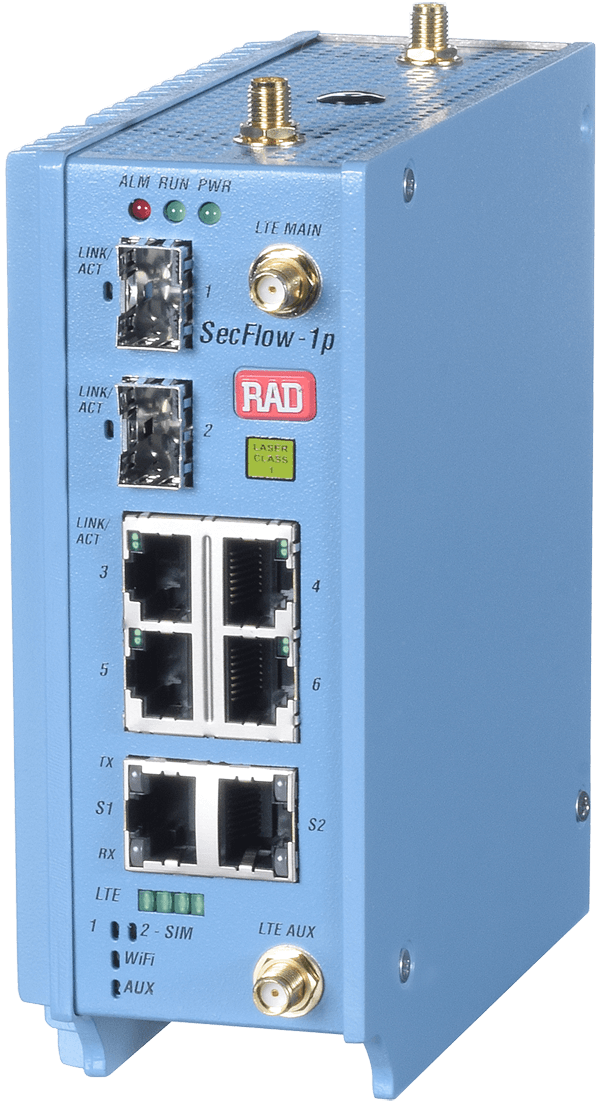
With our ruggedized SecFlow-1P IOT Gateway solution:
- Continue to use serial data communications over secure Cellular, WiFi, or Ethernet
- Solve legacy cellular communications where the use of cellular modem "AT" commands are still required
- Utilize Terminal Server functionality to bridge the gap between serial and IP remote management in ultra security
- Pass dry contact signaling
- Host third party software in an ultra secure and safe platform - Edge Computing Container
- Seamless communication with SCADA
- Provides link redundancy, Dual SIM redundancy for cellular, and optional LoRaWAN
- Supports VPNs, SSH, static routing, OSPF, VRRP, BGP, and DoS protection
- Support GPS via GNSS interface
Building ultra-resilient IoT communications with legacy requirements
Creating ultra-resilient communications requires a multilayered approach that incorporates physical redundancy, backup connectivity, policy-based failover mechanisms, and SD-IoT. Let’s look at each layer:
Physical Redundancy:
This is achieved by using multiple physical interfaces in the network CPE or IoT gateway. In addition to providing flexibility, these interfaces have to be redundant one to each other. There are several levels of physical redundancy.
Dual SIM Modems: Each modem supports two SIM cards to enhance reliability. If one cellular network fails, the system switches to the second SIM connected to a different carrier.
Dual Modem Platforms: Incorporating dual modems allows redundancy across technologies (e.g., LTE and 5G) or networks/carriers. For instance, in a dual LTE setup, a failure in one modem triggers a switch to the other, ensuring uninterrupted connectivity.
Gateway Redundancy: To protect against hardware failure, two gateways can be used, each implemented with a Virtual Router Redundancy Protocol (VRRP). The backup gateway acts as a clone of the primary gateway, automatically taking over if the primary fails.
Policy-Based Failover:
These are software-based solutions that can employ one or more of various mechanisms that define under which conditions the primary link switches over to the secondary/backup link. These mechanisms could be as simple as ICMP to a destination IP, which detects if the line is up. After a pre-determined number of failed attempts, the link will switch to the backup. Alternatively, routing protocols like OSPF or BGP can be used, with customizable thresholds for detecting connectivity issues. Users can define failover policies based on their requirements.
The first two methods are illustrated in the following use case:
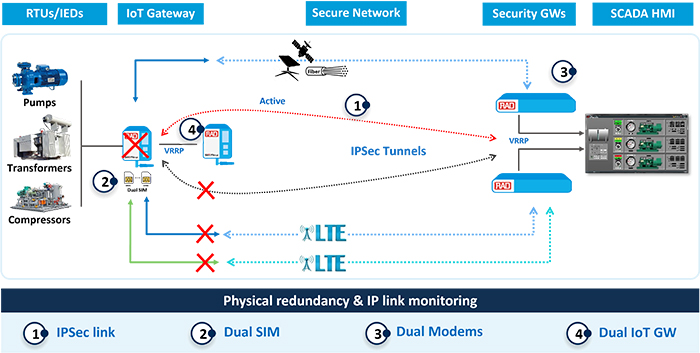
This is a very common use case that can be seen in water utilities, oil and gas, and power utilities, remote terminal units (RTUs or IEDs) are connected to an IoT gateway, which, in turn, is connected to a security gateway in the central site. From there, the data is transmitted to the supervisory control and data acquisition (SCADA) human machine interface (HMI). The primary connection is based on a IPsec tunnel over an LTE network. If a tunnel fails, automatic redundancy ensures a smooth switchover to the backup, demonstrating IP-Link Monitoring.
If a SIM card fails to register on the LTE network, automatic failover activates a second SIM, which opens a new PDP context over the LTE network – either the same one or a different carrier.
But what happens if the LTE modem experiences failure? In this case, the switchover will be to the second, backup modem, that can be connected over satellite, e.g., Starlink, or over fiber, another LTE connection or 5G.
And in case that we need a redundancy of the entire IoT gateway, we use the VRRP protocol to activate the clone IoT gateway and serve the same application seamlessly.
Advanced Resiliency Services – SD-IoT:
Given the zero-packet loss requirement of many new applications, the above methods, even when combined, are not enough. This brings us to software defined IoT. At RAD, we developed three SD-IoT services that enhance reliability and provide ultra resiliency for demanding applications:
- Load Balancing: Distributes traffic across multiple links at Layer 3, enhancing performance and reliability.
- Packet Duplication: Ensures zero packet loss by duplicating data packets across different links.
- Layer-over-Layer 3 Transport: Allows Layer 2 traffic to be carried over Layer 3 networks, ensuring flexibility in complex environments.
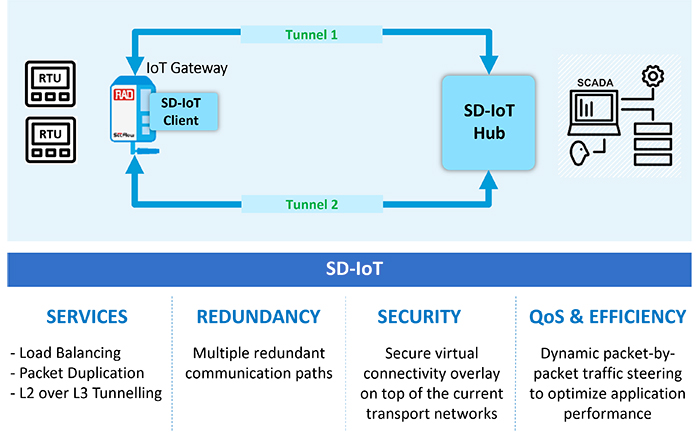
Here, instead of relying on physical redundancy, we are building an overlay solution, which includes an SD-IoT client and an SD-IoT hub. The SD-IoT client can distribute traffic over multiple links to connect to the SCADA HMI. The SD-IoT architecture presents several benefits and values: Starting with redundancy, multiple redundant communication paths, redundant to each other, can be used to transmit the data to the central site.
The second benefit is security. All links are based on SSL encrypted tunnels, ensuring that all data coming from the RTU to the central site is encrypted.
SD-IoT also supports quality of service SLAs and efficiency. For example, a load balancing service greatly increases efficiency as traffic is distributed – with different weights – over two links, delivering it to the central platform in the most efficient manner.
Let’s see how these values are coming into effect in various use cases.
SD-IoT: Transport Protection Using Packet Duplication
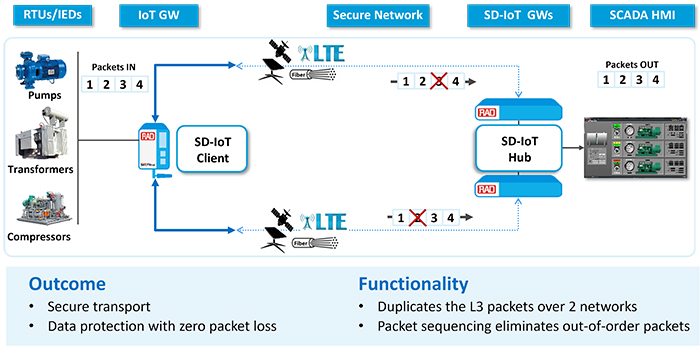
Let’s look again at a scenario where RTUs and IEDs that connect to the IoT gateway with an SD-IoT client, as seen in the diagram below. The data that we want to send are packets one, two, three, and four. In order to protect the data and ensure zero packet loss, the traffic is duplicated and sent over two links to the SD-IoT Hub in the central site. If there is a transmission failure, for example, if packet number three is lost on link one and packet number two is lost on link two, then the SD-IoT Hub can still aggregate the traffic and perform packet sequencing to eliminate out-of-order packets and delivering the data as intended. This service fits situations where the need for protected transport outweighs the need for efficiency.
SD-IoT: Layer 2 over Layer 3
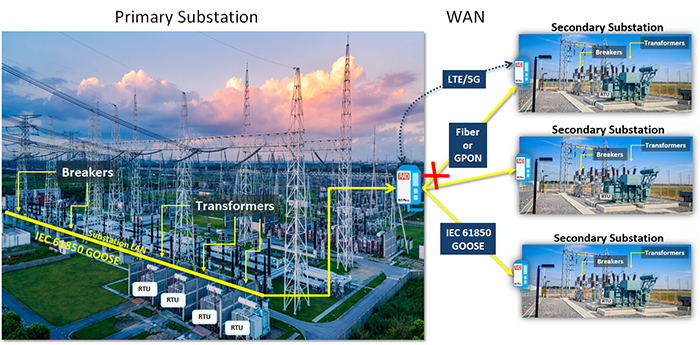
This is quite a unique service that addresses many challenges in the in critical infrastructure networks, as well as in other industries. Within modern substations, the traffic going between devices and controllers follows the IEC 61850 GOOSE protocol, which uses Layer 2 broadcasting messages. Nowadays, such messages need to traverse, not only inside the substation, but to neighboring substations as well. When transmitted over fiber, they can be kept as Layer 2, however this isn’t straightforward when there is a fiber failure. When the backup link is a cellular one, LTE or 5G, then it is a native Layer 3 link. To transmit Layer 2 messages over it, we use SD-IoT to encapsulate them and send them to the secondary substations using SSL tunnels. While the latency level would not be the same as over fiber – 30 milliseconds compared to under 10 – this still enables service continuity, alerting substations of events occurring at neighboring locations.
The Pulse Supply Advantage: Consult, Design, and Install
For SMR operators and engineering partners, Pulse Supply is more than an equipment supplier—we are a full-lifecycle partner. SMR communication deployment requires rigid adherence to statement of work (SOW) protocols, precise path analyses, and expert integration.
Our services include:
- Comprehensive Consult & Design: Custom-tailoring GAI-Tronics paging and phone networks to meet the exact acoustic and spatial footprints of your modular reactor layouts.
- Multi-Manufacturer Systems Integration: Seamlessly linking GAI-Tronics endpoints with back-end IP-PBXs, softswitches, or cellular gateways.
- Professional Staging, Installation, and Support: Delivering complete end-to-end setups, including physical data cabinets, specialized bulk fiber-optic cabling, wiring services, and ongoing service maintenance contracts.
Download Legacy IoT Industrial Documents:
Please call or
